Practical ideas for facilitating workshops & people development

I love to see creativity in workshops.

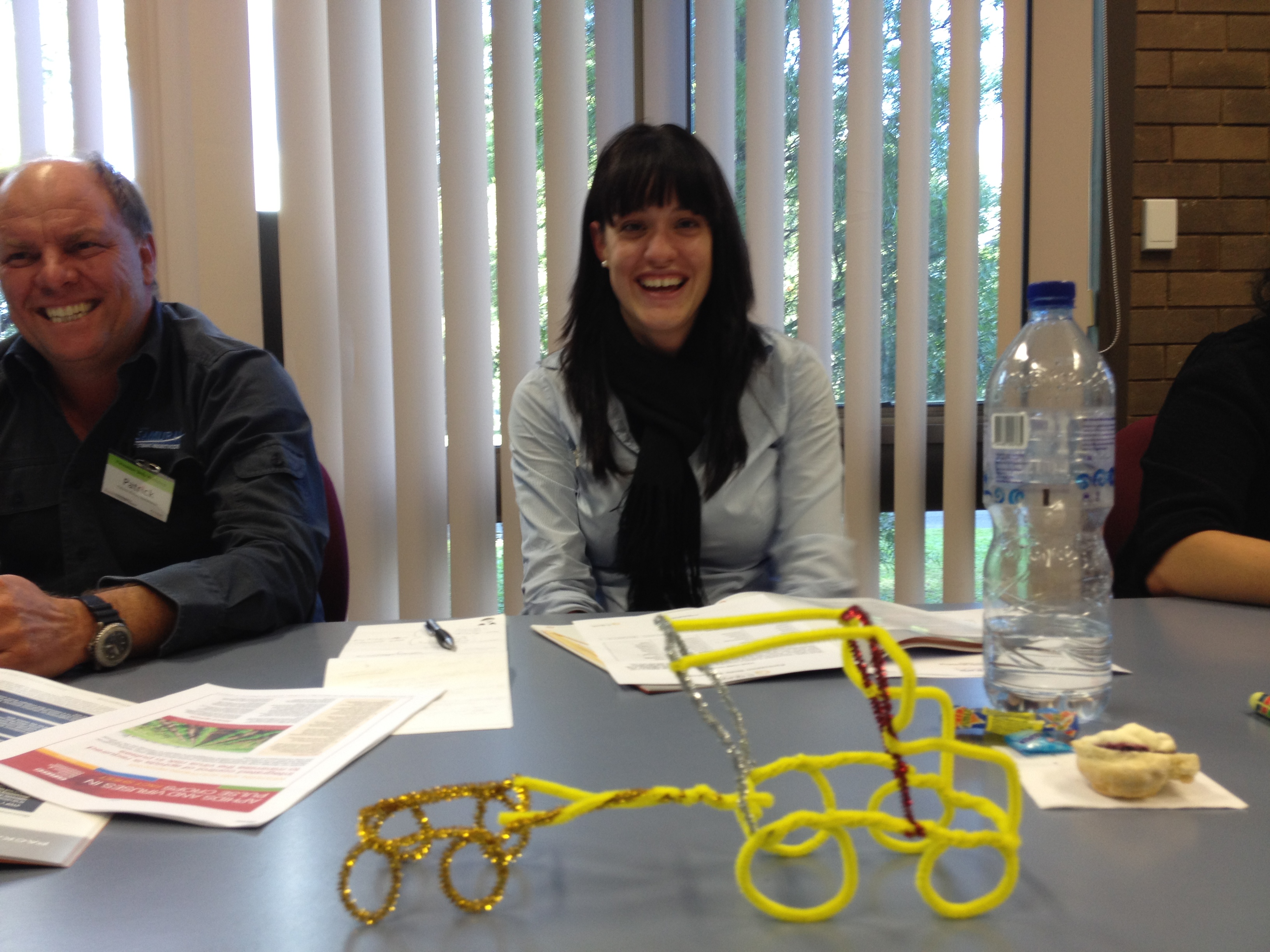
Providing things for participants to play with like pipe cleaners and stress balls is so simple and so effective.

Pipe cleaners can be made into all types of objects, fiddled with, rolled around fingers and the great thing about them is that they are quiet!

I’m always amazed at the adults in my workshops who are delighted when they discover the pipe cleaners are not on the table for a mysterious facilitative activity but are simply there to play with.

“Great, I won’t be sitting here clicking my pen!”

For many of us its a long time since we sat in a school class room all day, we are used to being busy, active and having things to do with our hands.

Kinaesthetic learners tell me their learning increases if they are busy doing something, and this includes playing with toys. It may appear like they are not interested or participating in the program; experience has shown me this is not the case.

Cheap shops provide a great array of soft toys, balls and blocks which can be put on the tables. They add a sense of fun and lightness and assist with creative thinking.

Recently one of the participants collected all of the pipe-cleaners at the end of the workshop and asked if she could take them for a meeting the next day!

Make the learning experience fun, enjoy the outcome and the creations!

Getting the pace right for the participants can be an art in itself.

A fellow facilitator and I recently participated in a training workshop, and as facilitators do, afterwards we discussed the process of the training as much as the material we had learnt. We both discovered that for us the pace was a bit slow. This lead to an interesting discussion about what is the right pace and the right pace for whom!

Our reflection on our own learning styles was that we are quite fast paced learners and like things to move along reasonably quickly. This lead us to the thought that were we facilitating in the way we like to learn. … so did that mean maybe we were too fast for some in our audience?

One of my goals in facilitation – from many years ago – was not to have people falling asleep in a session. I decided this counted as a personal failure – so my reflection was ….has this goal lead me to increasing the pace?

Since the dicussion I have taken note of the participants in my workshops and carefully observed their behaviour as a way of checking on pace.

I now check pace by:

  • observing the group carefully for signs, are they looking bored, flustered or appear engaged in the disussion and activities
  • asking someone in the break – so simple – choose a couple of people whose behaviour you may have noticed and someone that appears to be traveling OK.
  • have a question on your evluation form and ask the pace question – use a scale so a simple cross on the line will do.

Be aware of your own preferences and speed and how this might be influencing your style.

When participants say to me…  “Oh is it afternoon tea time already – gosh the day is flying past” …I think  – great – they are engaged in the material and activities and the pace must be about right for them. They are in flow and not noticing the time.

What’s the right pace for you?

Please add your stories or ideas in the comments with this blog.

To follow workshopswithwow enter your email address in the space on the right hand side of theis page. Each time I write a blog it will then appear in your in box.

What gives a field day the Wow factor?

This blog is a compilation of the emails and comments I have collected from my last post. I hope you all enjoy reading it and gain some useful insights into what gives a field day the Wow factor.

  1. Seeing or hearing something new – this could be machinery or a trial
  2. When planning the event the organizers have thought carefully about the objectives & key messages
  3. When the focus is on a few topics.
  4. Hearing the real life story from someone who has done it. Give the research or theory and then a practical case study of whats worked in the field and what could be done differently.
  5. Time for networking, name tags, time to introduce people and find about the other people at the event.
  6. Interactive sessions – get rid of the power points
  7. Plenty of time for questions and discussion
  8. Evaluation – having the opportunity to let the organisers know what worked well and what could be done differently. These need to be written so people can be honest with their answers.
  9. BBQ, great food
  10. Have a microphone!! A PA system with back up batteries, make sure people can hear whats going on.
  11. Be aware of the target audience and aim the information at the right level.
  12. Relevant up-to-date information
  13. Including some “blue-sky” research thats related to the region.
  14. Hands on activities in the trial – not all stand and listen
  15. Chairs to sit on around the site
  16. Independent advice from industry experts
  17. Field days that consider the needs of women – timing, location toilet and child friendly
  18. Opportunity for small groups discussions
  19. Be aware of the impact of the location and outside noise – good locations are accessible even when it’s wet, they are quiet (not with a train line or highway alongside the site)
  20. Being aware of why farmers attend these events – knowledge, social occasion, exchanging ideas, seeing something different and providing for all of these creates the wow.
The most commonly highlighted mistake was cramming too much into the field day – information overload, too many sessions, too many power points …

Thanks to everyone for your fantastic contribution to this Blog topic.

It doesn’t end here! Please continue to send through your thoughts and comments about great field days so I can continue my blog.

To follow this blog via email put your email address in the top right hand corner of this page – you will be send an email with a link to confirm you would like to follow the blog. 

Having the opportunity to observe a workshop is a great chance to watch the energy levels of the room and think about how to manage this effectively.

I believe keeping the energy up is the facilitators responsibility. I like participants to leave at the end of the session fired up with energy instead of drained and tired.

Some tips for energy management

  • Let your passion for the topic show. Passion breeds energy which will flow into the group.
  • Move, have the room set so you can walk into the centre of the room
  • Use different mediums – flip charts, activities
  • Use power point as little as possible
  • Move people around for different activities encourage them work with a variety of people
  • Ask people to sit in a different spot in the room, next to someone else, after a break.
  • Think about attention spans – how long is yours? apply this to the group
  • Use your voice to express a point, tell as story.

Enthusiastic participants add energy to the room,use this to enthuse others and not to dominate.

Be aware of the after lunch flat spot – about 2pm. This is a good time to include an activity which includes moving as well as using our brains. Be careful of asking the group if they would like to do an activity at this time. As humans we often take the path of least resistance when feeling flat, our role is to motivate them to get their energy back.

When the participants are flat be aware that sitting with them (on the same level) may also affect your energy. You need to make a conscious effort to stand up and move around putting energy back oonto the group when participants are flat.

When workshops end mid afternoon its even more important to get through the afternoon flat spot with an activity. I want my particiants to leave on a high not on a low. They are more likely to encourage others to attend if they leave full of enthusiasm.

Please share your ideas as comments.

If you would like to sign up to receive this blog via email enter your address in the space on the right hand side at the top of the page.

What makes a great Field Day?

There are hundred’s of field days run across rural Australia every year with varied success. I would like to collate your ideas so we can share the Wow factor and all enjoy more great learning opportunities.

  • What’s the most important thing that gives the Wow factor at field days for you? (why?)
  • What’s the big field day mistake? What would you do differently?

I’d love to hear from you and will share the collective wisdom in future posts.

You can add a your answers in a comment to this blog or email me on jeanette@agconsulting.com.au

I will also collate the responses and combine them into a document which will be provided to you as recognition of your valuable contribution.

To follow my blog by email you can sign up on the right hand side of this page

One of my pet hates is going along to a workshop where we are not given the opportunity to introduce ourselves to the others in room. Yes, you can argue it takes up valuable time especially in a short workshop, however, one of the key drivers for people to attend events is to network and meet like minded people.

A short introduction

  • provides safety, we all get a sense of who else is in the room and are more likely to share our experiences
  • gives an opportunity for the networkers in the room to identify whom they would like to talk to in the breaks
  • allows the introverts speaking time. If an introvert doesn’t speak early in the session they can often sit through the workshop and not have the confidence to share their ideas.
  • sets the scene for the workshop and builds the group or team

Robyn asked a question about timing with workshops especially with introductions. The way I like to handle this is by giving a time frame and clear instructions for the introductions. I will put this up on the whiteboard so it is understood by everyone.

For example

Introductions (in one minute)

  • name
  • location 
  • What attracted you to attend this session?

I find that if everyone is clear about the timeframe and the instructions they tend to stick to the guidelines and not ramble on. If they do ramble on, the pre-set timeframe gives the facilitator permission to politely close them down and move onto the next person.

Another tip is to ask everyone to write down their introductions, give them a minute or two to write down what they are going to say to the group. This gives the introverts thinking time keeps the extroverts quiet for a minute. It also means people have clarified their thinking and will listen to what the person speaking is saying rather than preparing their own introduction in their head.

Rather than working your way around the room ask for a volunteer to start and then move randomly around the room. I like to use a ball to throw around rather than creeping from person to person. The ball provides some fun and lightness to the process.

There are lots of great tools for introductions and icebreakers to build the group which I will cover in future blogs.

When to start the succession planning process?

I believe right now is a good time! If we think about it as part of the business strategic planning process and integrate it into our thinking it’s becomes an important part of ensuring business continuity.

Most members of family farms have the common goal that the farm should stay in the family. This is a great way to get the discussion started; there are plenty of examples of farms that have not remained in the family because the discussion never happened.

Certainly when someone is entering or exiting the business is an essential time to meet and discuss the effect of any changes.

Too often the discussion only starts when there is a family crisis, someone is unhappy, leaving the business or causing waves. Sometimes this is too late. However, as sensible as the process might seem, sitting around the table to discuss Wills, land transfers, retirements and pay outs understandably causes fear and emotion.

Getting everyone to the table at the same time can be difficult. Starting the process can be challenging and different generations will be ready at different times. For the older generation it wasn’t common practice for them when they entered farming. Assumptions made and many of them had to wait for the previous generation to exit,or even die, to take over the farming business. They often didn’t know what was in the Will until it was read.

This generation had to trust their parents to look after them and may expect the younger generation to do the same.

In contrast the younger generation are looking at farming differently – they have been encouraged to see it as a business which like any other small business should have a plan. They are looking for security for their future, to know what will happen and when.

Expectations are different and the generations need to be considerate of each others needs. Stephen Covey’s “Seek first to understand and then to be understood” is important for succession planning. Ask questions and really listen to the answers, ask more questions. Do your best to encourage open and honest communication.

Unfortunately there is not one forumla, every family is different with different personalities and needs.

A few tips for getting people to the table

  • demystify the process as much as possible, explain carefully what’s involved and what would be expected of people.
  • remind family members of the big picture goal and the need to ensure everyone is looked after while maintaining the business (if that’s the goal)
  • recognise the fear and emotion attached to succession planning and deal with this as it arises. Acknowledge the emotions and address them, don’t sweep them under the carpet or respond inappropriately.
  • hold the meeting away from the family home. Treating it like a business meeting in a neutral environment often improves behaviour and ensures the meeting is taken seriously. It can also stop us from retreating to childhood behaviours and habits.

And  always remember; we all do the best we can with the resources we have available to us!
Make your workshop start with Wow!

And I mean before your workshop even starts. What’s the atmosphere you want to create as your participants walk into the room? ….I want them to think “Wow this looks interesting I’m glad I made the effort to be here.”

Welcome your participants individually as they arrive. I love a quote by Robyn Henderson of Networking to Win – “If you are the host treate your guests how you would like to be hosted.”

How would you like to be welcomed as you arrive? By a facilitator who is aloof at the front of the room, someone who distances themselves as the expert, someone who is flat out getting organised for the event?

We have alll been the participant walking into a room for a workshops where we didn’t know anyone… how would you like to be treated? how would you like to feel? What would you like to see?

I like a friendly warm welcome so participants feel comfortable and at ease … here are some tips

  • Be organised! By the time your first participant walks in the room should be set up ready to roll.
  • Have a welcome on your flip chart or Power point slide – that way people know they are in the right place.
  • Greet each paticipant as they walk in – shake their hand … might seem like I’m stating the obvious, however, from experience it doesn’t always happen.
  • Have name tags ready … this makes life much easier for you, not only to introduce participants to each other,  but also if you are like me remembering names is not a strong point.
  • Introduce the participants to each other, if there is a conversation happening in the room , provide the new person with a lead into the conversation.
  • Some facilitators like to use music before the workshop and in breaks.. this can be effective, however think about appropriateness of the music and importantly the volume.
I highly recommend visiting Robyn Henderson’s site    www.networkingtowin.com.au  Robyn has great networking apply any of which apply to greeting and working with participants.


Finally …Wow! Thanks for all the great comments. You have all provided lots of topics for discussion and I’m really looking forward to tackling them over the next few weeks.

Send in your burning questions and comments …

Facilitation of farm succession is something I am very passionate about. Done well it keeps families together and farms in business, done badly, or not at  all, family support systems can be destoyed and so can businesses. My passion is driven from my own personal experience growing up on a family farm and marrying into a family farm, one family handled succession well and the other very badly.

These personal experience led me to completing Farm Family facilitation training with Lyn Sykes from Dubbo, ToP Facilitation training, Coaching training and an MBA so I could assist farming families with succession planning in a constructive way.

Accountants, lawyers and financial planners all play important roles in the succession process and often the most overlooked role is that of the facilitator. The facilitator will ensure the tough questions and the emotions are dealt with – they aim to assist the family achieve outcomes with shared understanding and common agreement.

Getting the whole family together is key to the shared understanding ….and I mean the “whole” family. The most successful meetings we have facilitated have included everyone involved in the farming business, this includes the siblings and their partners. The meeting provides an opportunity for everyone to put forward their views and perceived role in the future of the farm as well as their personal goals.

The other big misconception is that succession planning is about Will’s… this is only one part of the discussion. Succession planning is more accurately described as strategic planning or planning for business continuity. It includes discussions about business mentoring, business transition, roles and responsibilities, expectations and goals, retirement plans, plans for business growth, housing and more.

I’m not saying it is an easy process. Many families have never sat around the table and shared their hopes, goals and dreams for the future and at first it can be uncomfortable. After five years of working with families in South Australia I am still passionate about doing whatever can be done to keep families and farm together.

I would love to hear your comments…

What is your most pressing question about succession planning on farms?

The importance of great food has come up in every conversation I have had recently about the Wow factor. However, participants don’t seem to remember the details about the food unless there was something wrong with it.

Last year we ran a large workshop in Adelaide where we brought in a group of farmers from across the state, morning tea was on arrival and was enjoyed by all … there were several comments of appreciation about having a substantial morning tea after a long drive…. so we were off to a good start in the food stakes.

The morning workshops sessions all went well, interesting speakers, good interaction and discussion.

Lunch arrived and all looked good, large pizza’s and salad…but things were about to slide! There was only one piece of pizza per person .. and this was farmers we were feeding. We quickly spoke to the hotel caterers and requested more food…. well, too late for more pizza. They said they could provide plates of wedges…. and so they did. Many people had only wedges for lunch. Not exactly what we had in mind.

One of the questions on the feedback forms was “What did you find challenging about the workshop?” Well .. I’m sure you can all guess the answer to that question – lunch! Not only did the food affect the mood of the afternoon session it sabotaged our evaluation as well.

What went wrong – the event organiser who we originally booked the venue through was on holidays for the week. When we thought we had got it all right one last phone call to check the details would have made the difference.

Never overlook the importance of food in the Wow factor!