Practical ideas for facilitating workshops & people development

2013-06-09 14.46.39How often do we hear people say “I’ll be happy when……” Time to change our point of view!
Let’s all be happy now!

People are as happy as they make up their minds to be” Abraham Lincoln

I have been inspired by the work of Professor Martin Sellingman and Kathryn McEwen about happiness and resilience.

So what makes us happy? It’s all about attitude and importantly an ability to be present and enjoy “the now”.

Positive emotions – we have more control over our emotions than most of us believe we do. We can chose how we look at situations and how we might respond. The simple “gratitude” task, of identifying three things we are grateful for each day will make us focus on what has worked well, rather than what hasn’t, and make us feel happier with our lives.
When you go to bed tonight… go to sleep thinking tomorrow will be a great day – it’s amazing how changing our thought patterns can affect how we see the world.

Engagement – doing activities where we work in “flow” – the time simply disappears. What are the activities that you love to do, the ones that bring enjoyment and fulfilment? Understanding your strengths can help to identify this. Visit Martin Selligman’s website www.authentichappiness.org and do the VIA Strengths questionnaire to find out your signature strengths.

Relationships – I like to surround myself with positive people. People who give out energy, who enjoy life, are optimistic and fun to be with.
Having people in our lives we can rely on, we can off load on, to celebrate with and to cry with is important for our general well being and happiness.

Meaning – this is a sense of purpose – a connection to something bigger than ourselves and that we are making a contribution. This includes the application of your unique strengths and the development of virtues towards a larger end than yourself.

Achievement – Martin Selligman talks about Grit – the determination to work hard at something and to see it through. This sense of achievement of completing a task makes us happy. Our greatest motivator is a sense of progress and some recognition for this progress.

Martin Selligman has written several books about the art of happiness – Authentic happiness, Florish and Learned Optimism. I was very fortunate to hear him speak in Adelaide last year.

“The very good news is there are quite a number of internal circumstances, under your voluntary control, – if you decide to change them, your level of happiness is likely to increase lastingly – Selligman 

If you would like to follow my blog by email put your email address in the space on the top right hand side of the website. You will receive a confirmation email which you must acknowledge to receive the blog. I also have a facebook page www.facebook.com/Workshopswithwow


Planning for success

2013-04-11 14.20.35The biggest mistake made with workshops is cramming too much in. If we genuinely want people to develop new skills and knowledge which they can apply after the workshop use the KISS principle. Workshop developers often seem to think they must impart as much knowledge as possible in the shortest time frame possible, agendas are packed so full that by morning tea we have forgotten what was discussed first thing that morning.

When planning workshops I like to use  Bennetts Hierarchy, it provides a useful framework to refer to when you are developing the  agenda. I have simplified and modified Bennetts to make it practical for me.

Outcome – what is the intended outcome of the workshop, what is the big picture we are aiming to achieve? Gaining clarity about your outcome will help you design the right approach. Are you building skills or is your session about creating awareness?

Practice change – what do we want people to do differently as a result of attending our workshop or session. What tangible measurable change do we want them to make.

KASA changes – this is a very important step to consider

a. Knowledge – what knowledge is essential for the outcome and practice change. Lets not overwhelm people with everything we know and try to pump them full of every bit of knowledge on the topic we have collected over a lifetime! The trick is to make it simple to understand and impactful – provide links to extra information for the data hungry person, provide books for people to look at, and keep the information provided simple, easy to understand and apply and useful. What do they really really need to know!

b. Attitudes – this refers to the feelings/attitudes we are generating in the learning journey. What feelings do we want to create – confidence to make the change and meet the outcome, a positive, open approach to learning, a can do attitude?

c. Skills – the hands on doing. What do we want our participants to be able to do as a result of attending our workshop? How competent do we want them be when they leave to implement their learning’s? Remember knowledge doesn’t always lead to practice change where as skills development can.

d. Aspirations – what motivations do we want to instil in our participants. How do we want them to approach the practice change once they leave the workshop?

Activities  – once we have thought through these steps then we can start to think about the best activities to achieve our practice change while keeping the KASA in the front of our minds.

Resources – what resources do we need to complete our workshop activity; this can include our facilitation kit, venue, speakers, funding etc. These are the tangible requirements, which will make the workshop a success.

Now you have determined the knowledge and skills you would like participants to have and the activities to achieve the practice change the next step is to plan the agenda and think about the time frames required.

2013-04-20 11.44.12What does shifting a mob of sheep and building rapport with a group have in common? Good question!

I am often asked how to build rapport with a group of people … and have been reflecting on how I do this when facilitating.

From my childhood I shifted sheep on the family farm with my parents and continue to do so with my husband Bill. We were bringing the sheep home for shearing a few months ago … a good time to reflect and think. I was observing the mob, watching for the leaders, preparing for the break away when we got to gate and keeping eye contact with the “rogue” who was waiting for the opportunity to lead the others off in the wrong direction.

Powers of observation built up from childhood – scanning and watching for body language, making eye contact when required to hold attention, looking out for the signs of discomfort, boredom or time for a rest… developed subconsciously over many years. Skills learnt in one situation, which perhaps I have taken for granted, and applied to a different situation with equal success.

Just like the sheep groups of people will often have the rapport leader, the one the others copy and take the lead from. If you have the opportunity to sit an observe a group watch for the matching and mirroring of gestures and body language. The person leading is most often unaware of the role they are playing. When the facilitator is also in rapport with the this person the rapport is developed more quickly with the group. Being in rapport provides the opportunity to really connect with people, enhancing the whole learning process.

To develop the your skills of observation take some time out when catching public transport or take time to sit and watch large groups of people, look for the body language – train you eye to pick up on the signs of frustration, boredom and interest.

When at the front of the room it’s important to be present for the group, silence the “voice in your head” and be there for the group, watch for their signals. After a while this becomes innate and without realising it we are picking up the vibes of the group. If you are co-facilitating check in with each other about what you are each picking up from the group and reflect with each other afterwards about the rapport.

Go beyond merely communicating to ‘connecting’ with people. Jerry Bruckner

As this is my 50th blog I would like to thank my followers and readers for your on going support. If you know someone else who would benefit from my blog please pass it on.

To follow my blog by email enter your email address in the space at the top right hand side of the place and click confirm in the email you will be sent from WordPress.

IMG_3930Being in front of groups of people can be a daunting place until we get used to it. This blog aims to provide a few tips to think about when you “up the front”.

  • Be aware of your body language and what you are portraying to the group. As scary as it might seem being videoed while presenting or facilitating gives you a really good concept of what people see from the other side.
  • Move around the room with purpose.
  • Moving towards people who talk too much can help to quieten them down.
  • Make eye contact with your participants. Connect with each of them many times
  • Keep your body still – don’t sway, step back and forth or overuse body movements.
  • Use gestures to make a point, once again with purpose and intent. If you are the type of person who talks with their hands be aware of this and manage your gestures.
  • Be aware of what you do with your hands, putting them on your hips can be confronting to people. I often hold a marker pen as this makes me aware of my hands and stops my tendency for putting them on my hips or over gesturing.
  • Let your passion about the topic or activity show. Passion provides energy for the group and is contagious.
  • Breathe … while this might sound so simple when we are under pressure we often “shallow breathe” which makes us more up tight. Do some deep breathing exercises before you start and if you feel yourself getting up tight take a moment and breathe deeply. I remember clearly one of my first public speaking occasions where I started to speak and suddenly had a terrible headache … I had stopped breathing. I rushed through the experience and left feeling very unhappy with my presentation, if only I had remembered to breathe!
  • There are lots of great books about presenting to groups which provide useful tools for managing nerves.

The most powerful public speaking training I ever experienced was with a wonderful woman called Tessa Bremner. Tessa has trained politicians to make speeches in parliament and comes from a background in Theatre  Tessa facilitated training for several groups of rural women I was working with, she made the training fun and interactive. It was amazing to see the growth and development of skills of the women in only one day. Other than breathing and warming up before presenting, the tip I always carry with me from Tessa is to create a circle of light. Imagine a circle of light on the floor where you will stand, step into that circle and stand tall, imagine the circle is safe and provides confidence to you in your role. While working in the circle nothing else matters except the role you are in at the time.

Connect with your participants, spend time establishing the group at the beginning of the session to help you establish connection. I like to feel like I am member of the group who is guiding them through a process.

If you are a Facebook fan you can now “like” Workshops with Wow on Facebook and keep up to date with regular tips and tools.   http://www.facebook.com/Workshopswithwow
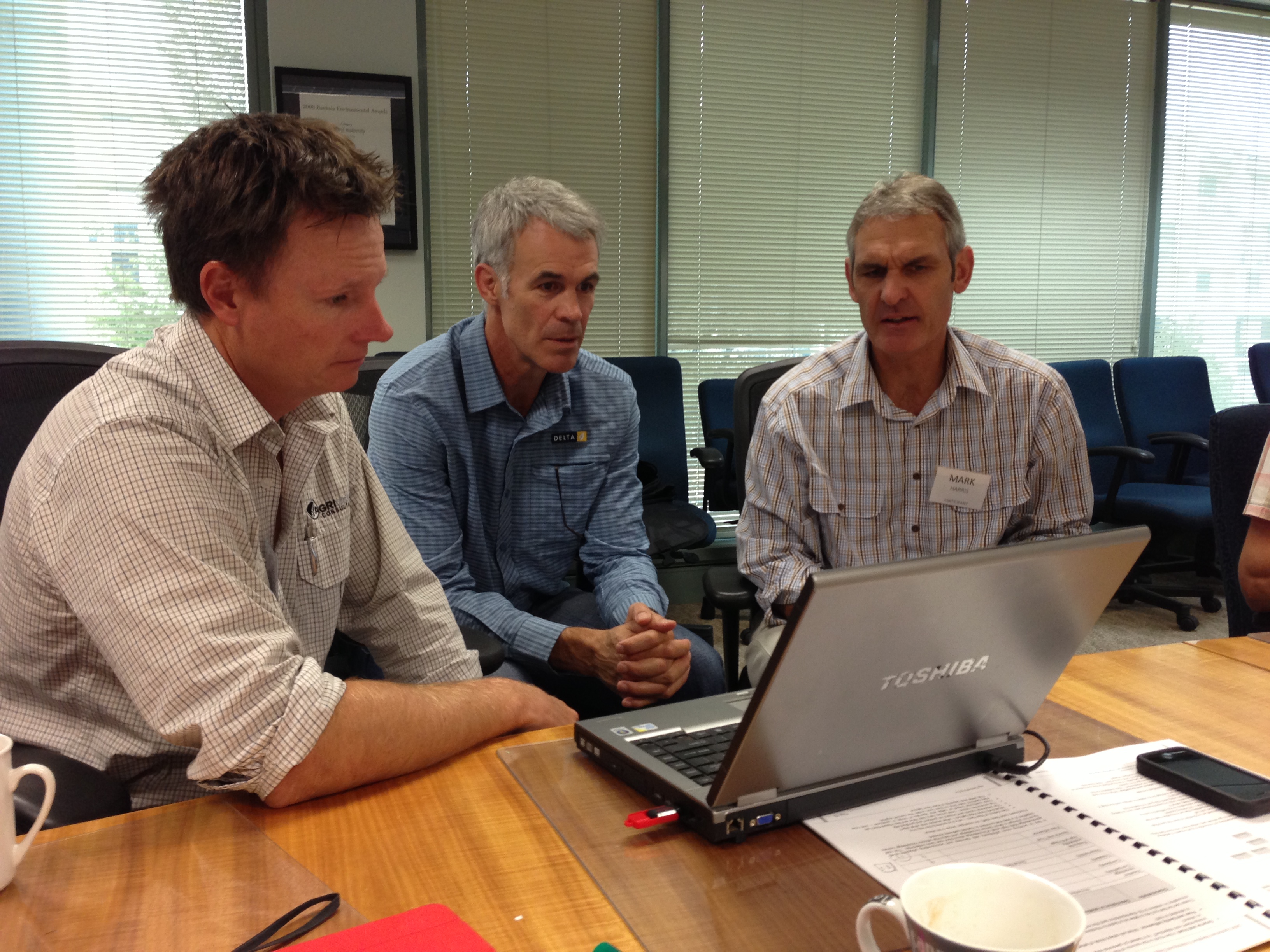
2013-05-28 16.14.40Facilitating larger groups provides a different set of challenges for the facilitator. This week Sharon and I ran our Facilitation Skills Workshop in Qld with a group of 30 professionals who work with beef producers.

Here are a few tips for working with a group this size

  •  Have tables set up with five participants per table, this is the maximum I would have at one table to ensure everyone is involved. More that this reduces interaction and provides the opportunity for the quieter members to “hide” within the group.
  • Check visibility – sit in some of the seats prior to the participants arriving to check you are able to clearly see the front of the room, the flip charts, other participants etc.
  • Having two facilitators is very important for variety and the ability to engage with the smaller groups. Our rule of thumb is one facilitators per 12 participants.
  • When developing the group guidelines ask if participants will move tables after each break. This assist with the energy in the room as well as ensuring the participants get to know each other and work with different personality types.
  • Introductions and icebreakers can be carried out at each table, however I still believe it is important for everyone to introduce themselves briefly to the whole group. This can be simply their name and where they are from.
  • Instead of collecting an expectation from each person one at a time and writing these up on the flip chart give everyone a black texta and piece of A6 paper. We asked everyone to write up one expectation, put their name on the paper and stick it up on our “sticky wall”. We then read through the expectations so everyone was aware of what people were expecting. At the end of the workshop we asked everyone to take their expectation sheet back from the wall and write a comment on how well this had been met. These we collected as part of our evaluation.
  • Table activities become very important in groups this size and its important to provide a variety of activities. A few ideas include
    • Group discussion, writing up ideas on the flip chart paper and reporting back to the whole group.
    • Group discussion and then collecting one idea per table – going around until all ideas have been collected. The facilitator can record the ideas from the front.
    • Building on each others ideas – each table has a topic and piece of flip chart they write their ideas and then pass the paper onto the next table who builds on the ideas and so on. Eventually the paper will return to the original table so they can review all of the ideas.
    • The sticky wall can be used to collect ideas or points of view from everyone in the room using the a6 paper and read through by the facilitator.
  • As our session included some training and practice we divided the group into two for a practice session.

If you would like to follow my blog by email put your email address in the space on the top right hand side of the website. You will receive a confirmation email which you must acknowledge to receive the blog.

Plenty for everyone

2012-05-09 16.40.24I’m a great believer in Adundance mentality – there are plenty of opportunities out there for all of us.

When I was writing this  I was sitting in bed with a cup of tea looking out at Wellington Harbour after facilitating in beautiful surroundings in rural NZ with groups of amazing rural women. The workshops are about women reaching ther potential, identifying their passion and purpose and developing goals. (First Steps – Agri-Women’s Development Trust)

I reflect on my own journey and the opportunity to attend a similar workshop in Australia over 12 years ago where I was introduced to the concept of abundance mentality and a simple quote from a mentor “We get what we focus on so be careful what you focus on”.

Since taking on this philosophy in my life I have met so many wonderful people and opened my eyes to the opportunities in front of me. As my facilitation and coaching skills have grown  I have had the opportunity to share these with others and in turn grow their skills.

How can we become more abundant in our approach to life?

  • Focus on abundance – not scarcity
  • Appreciate what you have in your life – one easy way to do this is to record 3 things each say you are grateful for each day.
  • Surround yourself with positive people with an abundant outlook on life – it can be catching!
  • Share – give out.  Be generous with your time, gifts and skills. Robyn Henderson refers to this as the “law of reciprocity” what you give out is what you get back . She also highlights the importance of” Giving without expectation”. www.networkingtowin.com.au
  • Look for the opportunities in challenging times – what can be learnt or gained?
  • Look for the win-win
  • Appreciate those around you – acknowledge others

The world is full of abundance and opportunity, but far too many people come to the fountain of life with a sieve instead of a tank car … a teaspoon instead of a steam shovel. They expect little and as a result get little.” Ben Sweetland.

IMG_0164I had never really seriously considered the concept of personal branding until I came across Matt Church’s books on Though Leadership. Matt talks about “signature style” and the need for it to be consistent, congruent and function.

I was reminded of this recently when Lindy Nelson from the Agri-Women’s Development Trust NZ was visiting Australia. Lindy presented to a rural women’s leadership program we were running and talked about identifying your leadership brand.

One way to get started is to think of some words you would like to come to mind when people think of you in that role. Then think carefully about the “how” you demonstrate this to the world. What have you done, or what will you do, to ensure the brand is congruent with “who” you are.

Asking others is a good way to get feedback and check in with the consistency of the message you are aiming to portray. Ask specific questions so you get clear worthwhile answers. A simple start is “What words would you use to describe me as a….”

As a facilitator, trainer and coach I have been thinking carefully about the brand thats important for me. The words that are important include: professional, inclusive, innovative, creative, outcomes focus, personable and sense of fun.

As Matt Church points out “its an expression of you, rather than an affectation of who you’d like to be.”

www.mattchurch.com

Branding must be true to who you are…what are the words that are important for your “signature style” and how do you portray these to the world?

If you would like to follow my blog by email enter your email address in the space on the top right hand side of the page. You will receive an email from wordpress which you must confirm to receive the blog.

Effective Flip Charts

IMG_0801I’m an avid user of  the Flip Chart, or as I tend to call it “butchers paper”. As my skills in facilitation have increased my reliance on powerpoint has decreased to the point I now rarely use it.

Todays’s blog is a few strategies in how I use Flip Charts effectively

  • Use colour – Mr Sketch Markers are a fantastic facilitation tool. I like to use lots of colour, borders, headings in different colours and usually write each line in a different colour so it is easier to distinguish as a participant.Be careful of some of the lighter colours, orange can be hard to read – however it is still great for headings.
  • Always, and I mean always, use the participants words. As soon as you change the words you have taken the ownership away from that person. This can be challenging with some extraverts who like to talk. Let them talk and then ask “What would you like me to write up here to capture your thoughts?”. If you remember from an earlier post extraverts like to think and speak at the same time- they will work through their thoughts out loud and then are usually very good at brining it back to a sentence. Listen carefully to the key words used by participants and always ask permission before changing anything. If you don’t understand what they are saying ask them “What would you like me to write down?”.
  • Put the flip charts up around the room so people can refer back to them. Once you have turned over the page no-one can see what has been discussed. Participants have told us they like the sheets to be put up in order and numbered so they can follow the flow of the session more easily.
  • Don’t worry about spelling – we are all human, if, like me, there are times the spelling simply disappears from your head, tell the group and someone  will almost always help – or put a “spell check” button on the corner of the page and make light of it.
  • Practice writing on the butchers paper – use print and make it large enough that people can read it around the room. It takes time to write neatly in straight lines on a flip chart.
  • Whenever you can, ask participants to work in small groups and let them record their own ideas – this can create more ownership in the process.
  • Keep the process underway while you are writing on the flip chart if possible, however don’t talk to the chart instead of the group and don’t hide behind the chart when reading comments back to the group.

I have received lots of great feedback about my pieces of “butchers paper” and find it a fantastic interactive facilitation tool.

Hope you all enjoy a great ANZAC day.

EL Bill Fungicides 2Tips for great field days – thanks once again to the GRDC Extension group for their ideas. I have build on their brainstorm with some other thoughts collected from discussions over the last 12 months.

Tips for great field days …

  • Well located – think about where the field day site is to be located. Is it easily accessible? If it’s a very wet season will people still be able to access the site? What is the noise level like? Is there a busy highway or train line close to the site which will impact on peoples ability to hear speakers?
  • Run on time – start and finish on time, value the effort people have made to be there. This includes the sessions during the day – speakers don’t feel valued if they have prepared for 30 minutes are then are cut short because the  person prior has gone over time.
  • Know and “name” the outcomes to be achieved by the event. A few well formed outcomes are more achievable than lots and lots!
  • Local, relevant and topical – what are the key issues being faced in the district right now.
  • Credible topics – how can this be integrated into my farm business?
  • Recognised farmer – utilise farmers where possible to tell stories and value add to the research with their first hand experiences.
  • Evaluate – follow up, how effective was the event? Were the agreed outcomes achieved? What worked well and what could be done differently next time?
  • Good agronomy – make sure the trials are well presented and in line with district practice.
  • Interaction time – ensure there is time for participants to views trials, ask questions and discuss what they might have learnt amongst themselves.
  • Good food – this is vitally important! Poor food will be all that is reported on so get it right!
  • Focus – not heaps of trials or topics.
  • Crop trial inspection time – focus on a few trials is more effectively than overwhelming people with lots to view. Think about how much you can take in during one session.
  •  Add something that is a “bit left of field” or “blue sky” to create some interest
  • BBQ  & beer to finish off the day and allow some very important networking time.

What other ideas do readers have about what makes a great field day?

If you would like to follow my blog by email enter your email address in the space on the top right hand side of the page. You will receive an email from wordpress which you must confirm to receive the blog.

2013-04-04 16.21.18Thanks to the GRDC Extension, Adoption Training and Support Group for their top tips on how to run effective training workshops and facilitated groups. The group met in Canberra last week where we reviewed farmer decision making, personality types, extension, adoption and evaluation.

The top tips are not prioritised – they were developed during a facilitated brainstorming exercise.

Training workshops

  1. Plan the event early
  2. Clear training packages and outcomes
  3. Topical and relevant dealing with current issues
  4. Accommodate different learning styles
  5. Evaluate the process
  6. Follow up after the workshop – ensure learning put into practice
  7. Interactive sessions – not all chalk and talk
  8. Recognise the knowledge in the room and draw this into the discussion
  9. Good presenters / facilitators
  10. Introduce the agenda and stick to it
  11. Practicality,think about – Relative advantage, trialabilty, observabilty, simplicity, compatibility
  12. Good take home resources
  13. Logical progression throughout the workshop
  14. Venue that works

Facilitated groups

  1. Establish the ground rules in an inclusive way
  2. Establish the group – take the time to do this properly and build ownership in the process
  3. Good facilitation skills to engage participants – ownership on driving the agenda of the group
  4. Good process and skill
  5. Group has purpose and expectations
  6. Understand the desired overview and stick to it
  7. Include everyone
  8. Stick to agreed timeframes
  9. Manage  the group and individuals energy
  10. Review and reflect effectively
  11. Evaluate
  12. Good planning
  13. Use a range of methods to accommodate learning styles