Practical ideas for facilitating workshops & people development

20130328-173225.jpgThanks for your time and you can thank me for mine .. and then after that’s said …. Forget it” –  Opening line from Rodriguez song ‘Forget it’ from his Cold Facts Album.

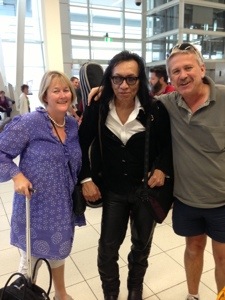
Following my last blog on Rodriguez you won’t believe what happened at Adelaide Airport last week.  I returned from NZ on Saturday and Bill was there to collect me. We headed down to get our bags and who should we meet at the baggage collection … Rodriguez!!

Being a shy person by nature I looked on as Bill introduced himself and had a discussion about his music and the influence it had on him. He told him he had been playing his favourite songs (Establishment Blues, Sugar Man, I Wonder and Rich Folks Hoax) on the guitar from the Cold Facts album just before he left to pick me up. He thanked him for his great music and the enjoyment it had provided over the years.

He told Rodriguez we were travelling to the blues fest at Byron Bay specifically to see him the following week and the he was the reason for our attendance at the festival. For a popular muso, he still seemed genuinely delighted that strangers approached him to tell him he was appreciated. Bill introduced me to his new friend (!!!) and this intriguing musician made a point of remembering our names and said ” make it a date” at Byron.

Bill was on a high for the rest of the week, having met someone he had admired for years and who had impact on his life.

Bill told the story of Rodriguez to an audience of 70 volunteer farm industry champions who work in farming systems across SA at a function on Tuesday. “Searching for sugar man” the story of Rodriguez highlights the importance of saying thank you and acknowledging people’s efforts for the work they do.

Motivational speaker, Mark McKeon had delivered a similar message to the group the evening before, suggesting the way to keep people in your business or organisation was to give three parts acknowledgement, one part challenge.

Great acknowledgements not only make the recipient feel good, it makes you feel good as well!

So I encourage you … Next time you see one of your personal heroes, mentors or someone you admired take the chance and recognise the impact they had on your life.

Hope you all have a great Easter
See you in the front row at the Rodriguez gig on Friday.

Sugar man

IMG_0919

One of my mentors – my husband Bill

Wow! what a story. Last night, Bill and I watched “Sugar man” the story about songwriter Rodriguez who released two albums in US in the early 70’s which didn’t even make ripple on the US music front. The same albums created a cult following during the depth of apartheid in South Africa selling over 500 000 copies.

Australia was the only other country in the world showing interest in the man they said was better than Bob Dylan.

The amazing thing was he didn’t know. He was still unknown in America and working his backside off as a labourer, struggling to raising his family and living in  26 different homes during this time.  While royalties were paid to his record company, not a cent was passed on so he didn’t have a clue about the impact he was having in South Africa at the time. (and on husband Bill and a few of his mates!)

Over 25 years later he was tracked down by a South African fan, who believed him to be dead, and he discovered the impact of his music in that country. Visiting South Africa in 1998 he performed to 6 sold out concerts … and then returned to being a labourer in US.

If only someone had contacted him!

His story blew me away… and took me back to my heroes and mentors. It made me think about  many of the people who had influenced my life  that I hadn’t taken the time to actually acknowledge for the impact they had on me.

In a country like Australia where we “knock the tall poppy” and berate success, we are not good at acknowledging. Imagine how powerful it could be if we had the courage to tell people genuinely what they had done and the impact they really had on our lives.

And I don’t mean a “thanks mate” or a “you did a great job”. I mean an acknowledgement with some “punch” behind it.

In our coaching and mentoring workshops we talk about acknowledgement as being authentic – from the heart. It focuses on the “who”  – the qualities demonstrated – what it really meant for you.

One of my mentors was my mother in law – a wonderful woman who demonstrated to me the importance of pursuing your passion in your career (amongst many other things). Sadly we lost her to cancer in 2000 and I never had the opportunity to tell her of the impact she had in my life.

Real acknowledgements are extremely powerful.

We can’t all have the impact of Rodriguez – such an impact on a country – but we can acknowledge the people who have an impact on us.

I leave you with the challenge to acknowledge your heroes and informal mentors … and I look forward to hearing the impacts!

PS – I also recommend watching the Rodriguez documentary – Sugar Man. An amazing story. (Bill and I are looking forward to seeing a 70 year old Rodriguez perform during Easter at the Byron Bay Blues Festival.)

If you would like to follow my blog by email enter your email address in the space at the top right of this page. You will receive an email from wordpress and you must confirm to be added to the email list.

The power of mentoring

2013-01-03 20.35.24We have all had a hero – a role model we have admired and shaped ourselves on.

One of mine was Meredith – Meredith was the chair of the SA Women’s Advisory Council – my first role outside of my local district.  I admired Meredith’s skills as a chair – she was warm, inclusive and kept us on track. Meredith was my informal mentor.

Imagine how powerful the relationship could have been if I had had the courage to ask Meredith to be my mentor – instead of watching and learning from afar I could have discussed with her what she was thinking, how she planned those meetings – and fast tracked my learning.

How many of you have had an informal mentor someone like Meredith you admired from afar?  What about a formal mentor?

What is mentoring?

“The mentor knows how to answer many great questions asked by the mentee and pass on their experience.”  The Forton Group.

The key for me in the definition is “questioning” The mentor is a guide who walks with the mentee – they have some of the  knowledge to answer the great questions however we don’t have to know everything to be a great mentor It’s more about sharing and developing of the skills of our mentee,  sharing our networks and questioning the mentee to assist them to develop their own skills and knowledge.  Creating possibility.

We have formal and informal mentors and it the formalising of the process that makes it powerful. We should encourage people to approach us to formalise the process and approach mentors ourselves. We are never too old to have a mentor, its not about age.

I will share of couple of personal mentoring examples …

1. Last year I was a volunteer mentor for APEN (Australasia-Pacific Extension Network) where I mentored a young woman for 8 months. I enjoyed working with her enormously – the benefits for me were fantastic – the sharing of her achievements and watching her grow in confidence.

“I had what I thought were a lot of professional difficulties but through mentoring my mountains became molehills and  I  learnt a variety of new skills to deal with my work. I gained work life balance which was practically non existent – my mentor taught me skills for life.”

2.   Over a year ago I approached a young woman who had transferred into South Australia in an agricultural role and offered myself as a mentor – the gremlin in my head was busy telling me “what did I have to offer” however I stuck my neck out and offered anyway – the young woman took up my offer and we continue to work together regularly.

In Ag Consulting Co we often work with young people who have chosen agriculture as a career and build mentoring into our training programs. These young people tell me regularly about the need for more people with mentoring skills in the industry

Mentoring is a skill underpinned by coaching and understanding the role of a coach greatly enhances the skills of a mentor. Training in the art of mentoring makes the relationship even more effective – the next blog will be about coaching.

It would be great to hear about some of your mentoring experiences… I look forward to some comments.

Facilitating with passion

20130220-051742.jpg

I love to facilitate – both facilitation in the pure sense helping a group develop a new strategic plan or way to work together, to facilitation of workshops which include delivery of some material and lots of activities which draw on the knowledge and experience of the participants to deepen learning.

It’s been 12 months since I started Workshops with Wow and it has been an exciting year for me, I have travelled to many parts of rural Australia and New Zealand working with wonderful rural people dedicated to agriculture and rural life. It is so inspiring to see the passion of people for their industry, group or organisation and to play a small part in their ongoing development.

My work with the Agri-Women’s Development Trust in NZ has provided me with a unique opportunity to work with NZ rural women. As I have fortunate to be part of them learning to “own their skills and talents” and identify their passions – I have also developed a deeper understanding of myself, my passion for people development and ownership of my skills.

Facilitating with my life and business partner, Bill, on farmer decision making and extension and adoption in the grains industry has been a highlight. We hope to continue this into the future – traveling together instead of in different directions – combining our interests of people and agriculture.

Writing this blog has provided me with the opportunity to share my passion and desire to enhance adult learning and facilitation – particularly in rural and regional areas.

Thankyou for following my blog and sharing in my journey I have really appreciated your comments, emails and personal feedback and look forward to continuing the facilitation discussion. Please feel free to share my blog with your friends and colleagues.

May 2013 be an exciting fulfilling year for you all – Jeanette

A career in agriculture?

IMG_0896

Young people choosing agriculture as a career is a continuing problem. At many of the sessions I facilitate in rural Australia it’s a burning topic – participants focus heavily on the students…

“How can we encourage high school students to consider ag?”

I have been giving the topic a lot of thought as my own children enter the university age – with two parents in the industry both are pursuing different career paths. During our sons primary school years we were in drought and by the age of 15 he said “who would want to be a farmer  – look how stressed you two are.”

Hmmmm…. what is the impact of environment and are we targeted the wrong timing? Let’s take a bigger view of the issue. Who and what are the key influencers of children’s choice of career? A couple of ideas are front of mind for me.

1.Age – targeting high school students is too late. Values and beliefs are laid down by the time they are in high school, I believe the key time to influence thinking is earlier than this…. Start the process in primary school during formative years.

2. Teachers have a large impact on our children’s thinking – many teachers do not have an interest in, or understand agriculture. A friend recently told me about his daughter who had decided to study ag and how she was actively discouraged by not only the teachers but also the career councillor.

3. Parents… I am going to focus here on mothers (my mother had a big influence on my choices). I have worked with 100’s of women on farms over my career and sadly many of them are not very happy. They fall in love with a man, marry him, the farm, the family and the business. Some families embrace the daughter in law, however many do not. Many women live in someone else’s home which they can’t make their own, live on a shoe string budget and work very hard. Poor succession planning often alienates them further. These young mothers are a key influencer of their children during their formative years – what are the subconscious messages that are being passed on?

At a workshop recently one of the women told me she was not encouraging her children to farm.

Yes agriculture is not limited to farming – there are thousands of careers in the industry – is this message really getting out there and to the key influencers?

Lots of issues here … what we need is a new perspective –  look at the impact of key influencers, timing, subconscious messages and some of the social fabric of how the industry operates.

What are your thoughts?

If you would like to follow my blog by email enter your email address in the space at the top right of this page. You will receive an email from wordpress and you must confirm to be added to the email list.

Learning to ski

2013-01-22 11.12.57Welcome back to Workshops with Wow and my first blog for 2013. I hope you have all enjoyed Christmas,a break and a great start to the year!

During January I was fortunate to travel to Japan, to Niseko, for a Skiing holiday with my husband Bill and son Will. I can’t ski ..so decided lessons would be good idea to get me started.

It was a great reminder for a facilitator and trainer to go through the process of learning a new (and challenging!) skill like skiing. My instructor was a young Englishman who had learnt to ski at the age of 2 1/2 ….he was completely unconsciously competent skier and had little teaching experience. For him I was a challenge – completely unconsciously incompetent !! I had no idea what I didn’t know and needed to be told exactly what to do in order to stay upright on those skis!

I left the lesson somewhat frustrated having learnt a few tips but not enough to get me off the magic carpet with the toddlers and onto the beginner slopes. Bill came to my rescue … a consciously competent skier … who had enough experience to know what he was doing and not enough that it had become a natural skill. After some mentoring by a very patient Bill I progressed to the beginner slopes.

The whole learning experience made me think carefully about the need as a trainer to be consciously aware of our unconscious competence! (That’s a bit of a mouthfull!) How important it is to go back and think through how we learnt the skill in the first place and then how we can teach that skills to a beginner. What were the key elements of the learning for us?

My poor young ski instructor learnt to ski as he was learning to walk …. how many of us could go back and teach someone to walk? Maybe more challenging than we think.

My other reminder was that there is a time to TELL – there are times when we don’t know what we don’t know. And equally importantly, when to move onto a mentoring or coaching role as people develop some confidence and practice the new skill.

Group size

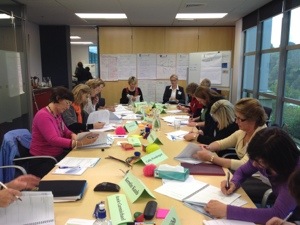
2012-12-04 15.11.36In the last few months I have facilitated groups varying in size from 25 to 6. What’s the best group size?

For me this depends on the outcomes required and the importance of a collaborative outcome.

In a perfect world my group size is 12 …

  • They are easily broken into groups of 3, 4, 2 or 6 …
  • Building the group at the start of the session is relatively easy with 12, people are happy to share thoughts and experiences. Once the number exceeds 12 the time taken to build the group trust is longer and some quiet members of the group will not interact at the whole group level at all.
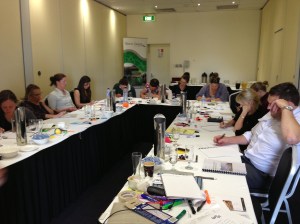
  • I like to use U shaped tables in a workshop and this also works well with groups up to about 12. With more participants I perfer round tables with groups of 5 at each table. Each table can then be treated as “one” with table discussions feeding into the overall.
  • I encourage people to move around during workshop sessions – setting this up in the “How we will work together” so after each break we sit next to someone different. This assists with generating new ideas and thinking as well as creating networking opportunities for the members of the group.

Venues can be challenging depending on there shape and size – often not giving us the choice we would like for room set up. I prefer to see the venue before the workshop – however this is not always possible when travelling long distances.

The most challenging venue we have facilitated in was an old town hall in country Queensland – the floor was wood and the acoustics terrible. Bad venues can have a big impact on the outcomes of the workshop – as was reflected in the evaluation sheets from this particular one.

The challenge of change

Working through change can be challenging – this includes changing a practice and/or taking on a new technologies with new skills. A framework I am finding useful is the stages of attitudinal change.

This simple model is highlighted in the photo in this blog.

When think about a new technology we are initially Ignorant of it, next we become Aware, followed by Intent to do something about it. We then reach a critical point where a decision is made to step over the line and Perform or not. Finally we maintain – continue to use or reject the technology.

The key to this model for me is how we present information at each stage of the model.

Ignorance – At ignorance people are not aware; we need to capture their attention. This is not a time to bombard them with fact sheets and information, these will most likely end up in the bin. We need to be thinking about the emotional hooks, what can we do to create attention to create the awareness.

Awareness – This becomes a time for information and fact sheets. However provide people with what they REALLY need to know, not every piece of information you have on the topic. Keep the information succinct, easy to follow and neatly packaged. Provide links to more information so the data hungry person can research themselves.

Intent – At this stage the thinking will be “how will this work for me?” , “How would I integrate this into my current system?” Provide coaching to assist with the decision making process so the ownership lies with the decision maker rather than the facilitator or coach.

Perform – Once the decision to take on the change has been made people move  to the “doing”. Support through mentoring is an ideal way to ensure the new skill is maintained. Further information and research may be required and the change may need to be “tweaked” to fit in with current systems or thinking.

Maintain – It is now necessary to evaluate the change, and modify or reject if required. In this fast paced world evaluation is a step that is often overlooked, a coaching or mentoring approach works well here. Further support to maintain the change may also be required.

This framework has been modified from  http://en.wikipedia.org/wiki/Transtheoretical_model by Bruce Howie whom I co- facilitated with in his workshop “How to drive adoption of technology.”

If you would like to follow my blog enter your email address in the space on the right hand side of the page and click confirm in the email you will receive. Please feel free to share my blog with other interested people … comments are also welcome. 

Guest Blog by  Bill Long 

Do you feel like no one is listening to you sometimes?

Understanding personality types will improve your understanding of the way people gather and process information and ultimately make decisions.

Understanding basic human behaviour and factors that influence decision making processes helps us assist the farm businesses we support to achieve their goals more effectively. There are many reasons why people choose to operate farms, some far more powerful than money. While advisors tend to deliver lots of data and information in order to persuade growers to think about a change in practice, intuitive decision making processes are preferred by farmers and are fed by a range of factors including formative years and adult learning experiences, family values, beliefs, emotions, gender, genetics and needs during the various stages of life we go through.

This article discusses just one of these factors – personality type and its influence on farmer (and human) decision-making process.

Creating frameworks to describe human behavioural patterns can be a useful way to anticipate individuals’ responses to situations. Understanding personality ‘types’ can help our understanding of likely behaviour and assist us in understanding our own and others’ abilities and preferences to perform tasks. Once some of these behavioural patterns are understood, we can tailor our approach to supplying and using information with individuals.

Strachan (2011), reports on one of the few attempts in Australia to define the rural culture using the Myers Briggs type indicator. The data source of this study came from 3000 farm managers and employees working in six major agricultural industries across Australia over a 15 year period.

The profiles of people working across a range of agricultural industries were compared with the Australian standard sample.

Table 1. Distribution of “temperaments” in selected rural industries. Strachan (2011)

SJ SP NT NF
Beef 57% 25% 13% 5%
Cropping 52% 25% 17% 6%
Intensive 57% 22% 15% 5%
Australian sample 42% 13% 26% 18%

The” SJ” temperament (52%) describes a culture that is less likely to adopt new ideas and will resist change. Decision makers within “SJ” temperament need to be convinced of the need to change. As a group, “SJ” adults tend to define themselves by their experience and they have a deeper investment in its value. Unless there is a clear and desperate need to change, “SJ” types prefer to stick to set procedures, established routines and historic precedents to guide them and prefer practical, concrete problems rather than theoretical or abstract concepts involved in adoption of new ideas. The ideas need to be complete, packaged well, have the relative advantage for change clearly evident, need to be compatible with current practices and thinking (not too way there), simple to adopt with a short term return on investment obvious. They are the most risk adverse type.

The “SP” types (25%)are impatient with abstraction and theories, often have a “do it now and fix the details later” approach to problems and take a flexible and adaptable approach to organising their time. They don’t mind taking risks and like the “SJ’s” like concrete problems and prefer guidelines and take a step by step approach to problem solving and learning.

The “NT” (17%) type strengths include problem solving and understanding complex systems. They enjoy pioneering almost anything and like to start new projects and may have trouble sustaining interest after the design phase. They value logic and knowledge. Intuitive (N) types are more likely to tackle new ideas –they are willing to “have a try” at new technology without having the fine detail “packaged “for them. Often the detail simply isn’t there. This may not be the most successful approach to long term business success as the “cost” of new learning in farming can be extremely high. Being the “first” to try new technology often results in mistakes being made along the journey resulting in crop damage and lower yields.  This type is the obvious type to approach to try the latest technology.

The “NF” (6%) types value authenticity, integrity and harmony – may see their life as one long search for meaning. They are great participatory decision makers – focussing on the people in the organisation. They have energy and enthusiasm for the things they believe in and can have a tendency to ignore problems in the hope they will go away. These types could be approached to organise group events and collaboration on new ideas. They engage well with others.

Although these frameworks tend to categorise individuals as having certain behavioural traits, it is important to recognise that these traits or types are really ‘preferences’ to type. It does not mean that individuals can’t behave differently. By creating awareness of one’s preference to automatically react or behave in a particular way, we can train ourselves to deliver and respond in a different manner if desirable.

Recognising that we don’t all think the same way is the first important step in delivery of information. Just because we might like information presented one way, that doesn’t mean others have the same preference. We can modify our message delivery techniques to include all personality types and get our message across more quickly and effectively.

With approximately 80% of the farming population being “S” types, it is of little surprise that new and innovative technology that might excite an “N” type may take a while to be adopted.   Think about the way your information is packaged and presented. And after that is done, consider some of the personal reasons (values, beliefs etc.) that might influence decision making process.

Now they’ll listen!
Personality J’s and P’s

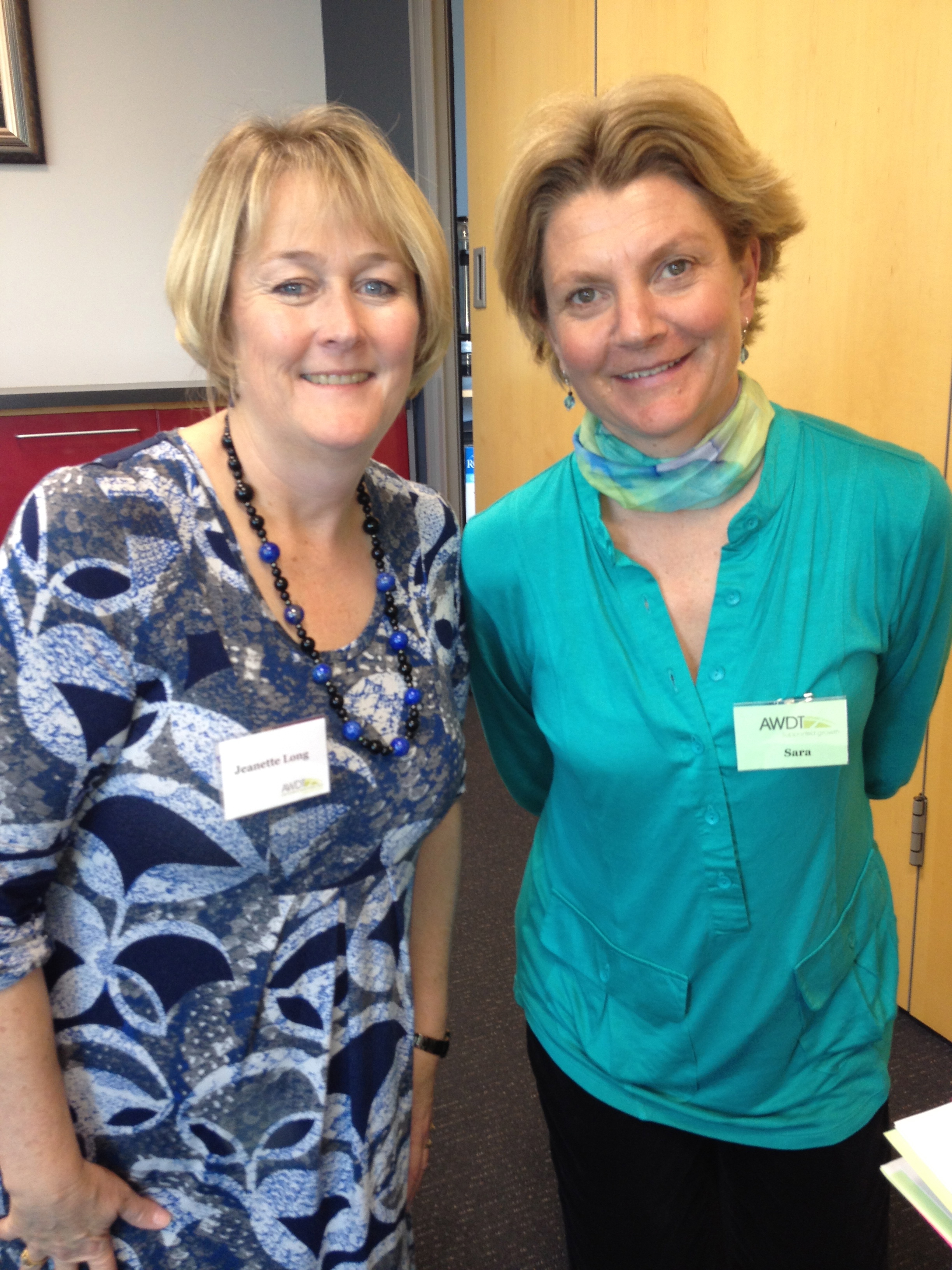
In NZ with Sara Heard

Welcome to the fourth blog about the Myers Briggs  Type Indicator (MBTI) and a few tips about how I relate this to facilitation.

Judging Types (J) like to get things settled and finished, work best when they can plan their work and follow the plan. Are self-regimented, purposeful and exacting. So yes you guessed it; J’s like to have the agenda and stick to it. They like workshops to run to time and finish on time. J’s can find it stressful if the workshop runs over time as they probably have something else in their schedule.

Perceiving Types (P) adapt well to changing situations, they are happy to leave things open for alterations as time progresses. They live according to the situation or moment and adjust themselves easily. P’s love a constant flow of new experiences -they are curious, flexible, adaptable and tolerant.

From a facilitator perspective (as a J myself) I always have breaks on time and finish on time. I have learnt over the years to take a flexible approach to the material or process in the workshop and not provide a “too exacting” or detailed agenda. (remembering to provide enough detail for the “S” Types) This approach enables to J’s to feel we are on time and a sense of control but enables to P’s to explore the material in the workshop and satisfy their curiosity.

One of the challenges for me is co-facilitating with a P who may not have the same “importance of time” I apply to my sessions. As a J something I find the most challenging is when we have agreed on a timeframe for topics and the P I’m working with runs overtime – reducing the time for my section of the agenda.

You have probably worked out the MBTI is a passion of mine – I love to observe personality and behaviour – link to frameworks and consider how this might apply to my work and life. I’m currently developing a workshop on adoption of technology which I’m finding really engaging – working in flow with the time disappearing as I become more creative! Typical behaviour for an INTJ 🙂

More of this in later blogs.

I would love to hear your thoughts or comments on my personality blogs areas for more discussion.